
Meet · 13 minute read
The History of Robot Pets: From Sony AIBO to Today
Robot pets evolved from simple machines that looked alive into companions built around recognition, memory, touch, and character. Their history explains why emotional design matters as much as robotics.
Updated August 20, 2026
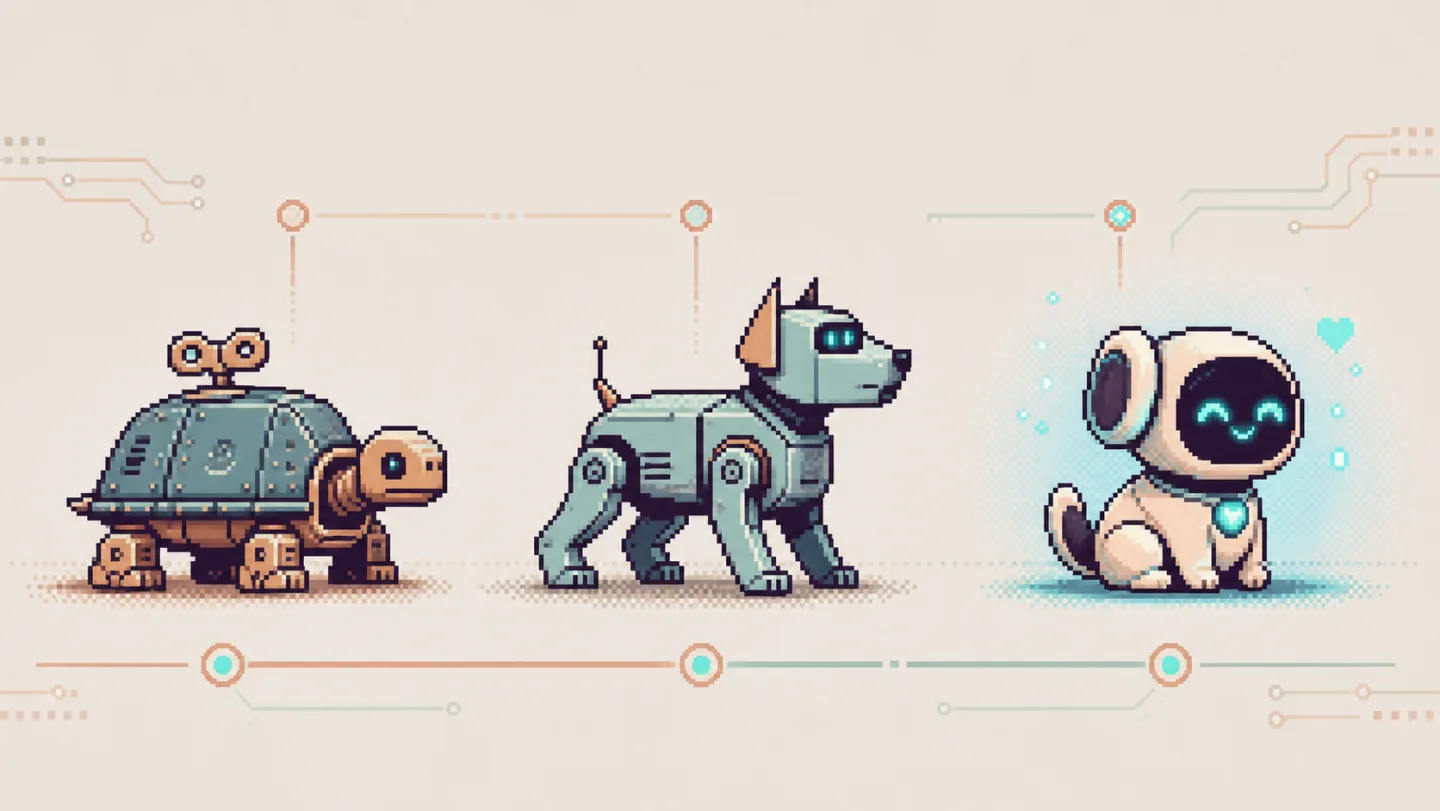
Robot pets have gone from a Tokyo lab curiosity to a product category that Casio, Sony, and a dozen startups are betting their futures on. The history of robot pets is really the history of a single question: can a machine make you feel cared for? Twenty-seven years after Sony's first AIBO sold out in twenty minutes, the answer is turning out to be a very interesting "yes, sort of."
This guide traces the full story of physical AI pets: the early toys that hinted at the idea, the AIBO era that defined it, the therapy robots that proved it had medical value, and the 2020s generation that is finally combining machine learning, soft materials, and real emotional modeling. If you're deciding whether to bring a robot companion home, or you're simply curious how we got here, this is the complete timeline.
Before AIBO: The Mechanical Ancestors (1950s–1998)
Long before anyone used the phrase "AI pet," engineers were building machines that behaved like animals. In 1949, neurophysiologist William Grey Walter built two tortoise-shaped robots, Elmer and Elsie, that could seek light and return to their charging hutch when their batteries ran low. They weren't pets, but they established the core idea that simple rules could produce behavior that looked alive.
The toy industry picked up the thread decades later. In 1985, Tomy's Omnibot rolled into living rooms as a programmable butler, and in the same era wind-up and battery-powered dogs that barked and walked were staples of every toy catalog. These were puppets, not companions, because nothing inside them responded to you.
Then came 1998 and Furby. Tiger Electronics' owl-hamster hybrid had infrared sensors, a light sensor, a microphone, and a tilt switch, and it used those inputs to "learn" English over time by gradually swapping its made-up Furbish vocabulary for real words. The learning was scripted rather than genuine, but the emotional effect was real. Forty million Furbies sold in three years, and the toy proved a commercial truth every robot pet maker has relied on since: people will bond with a machine if it appears to notice them.
1999: Sony AIBO Creates the Category
On May 11, 1999, Sony put 3,000 units of the ERS-110 AIBO on sale in Japan. They sold out in twenty minutes. Two thousand more for the US market were gone in four days. The Sony AIBO was not a toy; it was a legitimate autonomous robot built on Sony's OPEN-R architecture, with a 64-bit RISC processor, a color camera, stereo microphones, touch sensors on its head and back, and eighteen degrees of freedom in its limbs, tail, and head.
What made AIBO revolutionary was the software. It had a simulated instinct and emotion model, with internal states like happiness, anger, fear, and curiosity that shifted based on how it was treated. It grew through life stages from puppy to adult over weeks of interaction. Each AIBO developed a slightly different personality depending on its owner, which is exactly the feature that makes people grieve when one breaks.
Sony iterated aggressively. The ERS-210 in 2000 added voice recognition and a more dog-like face. The ERS-7 in 2003 was the high point of the first generation, with Wi-Fi, the ability to read specially printed cards, face recognition, and a mouth that could pick up its own toy bone. Researchers loved it too: the RoboCup Four-Legged League used AIBOs as its standard platform for years, making it one of the most studied robots in academic history.
Then, in January 2006, Sony shut the whole program down as part of a company-wide restructuring under CEO Howard Stringer. Roughly 150,000 first-generation AIBOs had been sold. Sony kept repairing them until 2014, after which a cottage industry of independent repair shops in Japan took over. In 2015, a Buddhist temple in Chiba prefecture began holding funerals for AIBOs that could no longer be fixed, with monks chanting sutras over rows of robot dogs whose parts would be donated to keep others alive. That image, more than any spec sheet, tells you what the first AIBO accomplished.
The Toy Robot Boom (2000–2010)
AIBO's success inspired a wave of robot animals aimed at the mass market.
Poo-Chi (2000), designed by Sega Toys and distributed by Tiger, was a mass-market AIBO-inspired toy with LED eyes and simple touch responses. It sold over ten million units and spawned Meow-Chi, Chirpy-Chi, and Dino-Chi.
Tekno the Robotic Puppy (2000) from Manley Toy Quest claimed over 160 emotions and sold around seven million units in its first season, making it one of the best-selling robot toys ever.
iCybie (2001) from Tiger/Silverlit was the most ambitious of the budget dogs, with sixteen motors and infrared obstacle sensing.
Pleo (2007) from Ugobe was the most sophisticated of this era. A baby Camarasaurus dinosaur designed by Furby co-creator Caleb Chung, Pleo had thirty-eight sensors, fourteen motors, and an operating system called "Life OS" that let it develop from a hatchling with genuine unpredictability. It was difficult to manufacture sustainably, and Ugobe went bankrupt in 2009, but the Pleo name was revived by Innvo Labs and remains a cult favorite.
Zhu Zhu Pets (2009) went the opposite direction: cheap robotic hamsters with a handful of sensors that became the must-have Christmas toy of the recession year, selling tens of millions.
The lesson of this decade was that believable behavior mattered more than raw capability. Pleo was the most "intelligent" and sold the least. Zhu Zhu Pets were the simplest and sold the most.
Paro and the Birth of Therapeutic Robot Pets (2003–Present)
While toy companies chased Christmas, Japan's National Institute of Advanced Industrial Science and Technology (AIST) was building something different. Paro, a robotic baby harp seal developed by Takanori Shibata, was first shown in 2001 and went on sale in Japan in 2005.
Paro was deliberately designed as a seal rather than a dog or cat so that users would have no real-world reference to compare it against. It has five kinds of sensors (tactile, light, audio, temperature, and posture), learns to respond to the name its owner gives it, and remembers which behaviors earn strokes versus hits. It weighs about as much as a human baby, and it was engineered for one purpose: to calm people with dementia.
In 2009 the US FDA classified Paro as a Class II medical device, the first robot pet ever to earn that status. Dozens of studies in nursing homes across Japan, Denmark, the US, and the UK have since examined agitation, stress markers, and social interaction among residents who spend time with Paro. It is used primarily in care settings and established an important argument for robot pets: they may offer useful support where a living animal is impractical.
Hasbro brought the idea to a wider consumer audience with Joy for All Companion Pets in 2015, later spun off as Ageless Innovation. These robotic cats and dogs have built-in sensors that respond to petting and voice, purr with a vibration motor, and have been distributed by state aging agencies across the US, including a widely reported New York State program that sent thousands to isolated seniors during the COVID-19 pandemic.
2018: AIBO Returns
In January 2018, twelve years after killing it, Sony brought AIBO back. The ERS-1000 (styled "aibo" in lowercase) was a complete rebuild: a 64-bit quad-core processor, two OLED eyes capable of nuanced expressions, twenty-two axes of movement, a fisheye camera in its nose and a SLAM camera on its back for mapping your home, and cloud connectivity that let it continually refine its personality.
The new aibo paired premium hardware with a cloud plan that stores its memories and personality. It can recognize faces, learn tricks taught by other owners through the aibo community, patrol your house on a schedule, and find its own charging station. Sony sold 20,000 in the first six months and crossed 100,000 units by 2022. Aibo is still on sale in 2026, now marketed less as a tech marvel and more as a family member, with a hospice program that lets owners donate retired units so their parts can keep others running.
The 2020s: AI Pets Get Soft, Smart, and Emotional
The current generation of robot pets is defined by three shifts: machine learning replacing scripted behavior, soft fur and fabric replacing hard plastic, and large language models giving some pets the ability to actually converse.
Lovot (Groove X, 2019) was the first to make warmth itself the product. Designed by former Pepper engineer Kaname Hayashi, Lovot has no practical function whatsoever. It rolls around on wheels, maintains a body temperature of about 37°C, makes eye contact with its big animated eyes, and asks to be picked up. It has more than fifty sensors and a ten-core processor dedicated to looking alive. Despite its premium hardware and ongoing service plan, Lovot found a real audience in Japan and is now sold in the US.
Vector (Anki, 2018) was a palm-sized robot with a personality and cloud AI that won enormous goodwill before Anki collapsed in 2019. Digital Dream Labs acquired the assets and has kept Vector alive through subscriptions and community effort, a story that raised the uncomfortable question of what happens to a cloud-dependent pet when the company behind it dies.
EMO (Living.AI, 2021) and Eilik (Energize Lab, 2022) brought the desktop robot pet concept to a wider consumer audience, with animated faces, touch response, and compact bodies designed for a desk.
Loona (KEYi Tech, 2022) is a wheeled, big-eyed robot with face recognition, gesture control, a 3D time-of-flight sensor, and GPT-powered voice conversation, sold as a consumer smart pet. Loona is probably the best example of the modern "smart pet": it plays fetch, reacts to being chased, recognizes its owner, and can also answer a homework question.
Casio Moflin is a defining mid-2020s design. Originally developed with Vanguard Industries and funded on Kickstarter in 2021, Moflin is a handheld, furry creature with no face, no limbs, and no screen. It uses touch, sound, motion, light, and temperature sensing, plus an emotion model that Casio says can produce more than four million personality variations. Casio launched it in Japan in late 2024 and later brought it to the US. It represents a bet that emotional nuance matters more than a long feature list.
Tombot Jennie, a hyper-realistic robotic Labrador puppy developed with Jim Henson's Creature Shop, was presented publicly as a lifelike companion for older adults; its maker continues to study care applications, continuing Paro's lineage with a far more approachable form.
CES 2026 also saw An'An, an AI panda from Mind with Heart Robotics built for elder care, and a wave of Moflin-style fur companions from Chinese manufacturers like Ropet and Fuzozo. The category that Sony invented and then abandoned is now the most crowded it has ever been.
What the History Teaches Us
A few patterns run through three decades of robot pets.
First, emotional believability beats intelligence. Furby, Poo-Chi, Zhu Zhu Pets, and Moflin all succeeded with minimal processing power because they reacted convincingly to touch. Pleo, arguably the most advanced pet of its era, bankrupted its maker.
Second, the business model is fragile. Sony killed AIBO, Anki killed Vector, Ugobe killed Pleo. A robot pet that depends on cloud servers can die when its company does, which is why subscriptions and open-source communities have become central to the category.
Third, care settings are an enduring use case. Paro has been in continuous production since 2005, and consumer companion pets have been distributed through public aging programs. Research is mixed, but the practical appeal is clear where a living animal is not feasible.
Fourth, software is becoming as important as hardware. The personality engine that made AIBO special in 1999 lived inside a complex robotic body. Today adaptive character systems can inhabit phones, desktops, browsers, or small connected devices. AI Pets takes a character-first approach inside a physical ESP32 companion: the body provides presence while voice, memory, and personality provide continuity.
Robot Pet Timeline at a Glance
| Year | Milestone |
|---|---|
| 1949 | Grey Walter's tortoises Elmer and Elsie |
| 1998 | Furby launches, 40M sold by 2001 |
| 1999 | Sony AIBO ERS-110 sells out in 20 minutes |
| 2000 | Poo-Chi and Tekno bring robot dogs to mass-market toy shelves |
| 2003 | AIBO ERS-7, the peak of the first generation |
| 2005 | Paro therapeutic seal goes on sale in Japan |
| 2006 | Sony discontinues AIBO |
| 2007 | Pleo the robot dinosaur ships |
| 2009 | Paro becomes an FDA Class II medical device |
| 2015 | Hasbro Joy for All Companion Pets; first AIBO funerals in Japan |
| 2018 | Sony relaunches aibo ERS-1000; Anki Vector ships |
| 2019 | Groove X Lovot goes on sale |
| 2021 | Moflin funded on Kickstarter; EMO ships |
| 2022 | Loona and Eilik launch |
| 2024 | Casio releases Moflin in Japan |
| 2025 | Moflin launches in the US and UK |
| 2026 | Tombot Jennie and An'An debut at CES |
Frequently Asked Questions
What was the first robot pet? Furby (1998) is usually credited as the first mass-market robot pet, but Sony's AIBO (1999) was the first genuinely autonomous robot pet with a learning personality. Earlier mechanical animals existed, but they couldn't respond to their owners.
Is Sony still making AIBO? Yes. The ERS-1000 aibo, relaunched in 2018, is still sold in Japan and the US in 2026, along with a cloud subscription plan.
Why did Sony discontinue the original AIBO? In 2006 Sony cut AIBO along with its QRIO humanoid project as part of a broad restructuring aimed at refocusing on profitable core electronics.
What is the most advanced robot pet today? For raw capability, Sony aibo remains the benchmark. For emotional modeling, Casio Moflin and Groove X Lovot are the most sophisticated. For conversation, Loona and EMO use large language models.
Do robot pets help with loneliness? Multiple studies of Paro and Joy for All pets report reduced loneliness and agitation among older adults, and Casio explicitly markets Moflin as a response to social isolation. Results vary by person, and robot pets are a complement to human contact rather than a replacement.
Related reading on aipets.com: The History of Digital Pets: From Tamagotchi to AI Companions · Best AI Pets and Robot Companions of 2026 · How AI Pets Actually Work