
Meet · 12 minute read
The History of Digital Pets: From Tamagotchi to AI Companions
Digital pets began with a few pixels and a need for care. Three decades later, the same emotional loop is being reshaped by conversation, persistent memory, and expressive AI characters.
Updated August 20, 2026
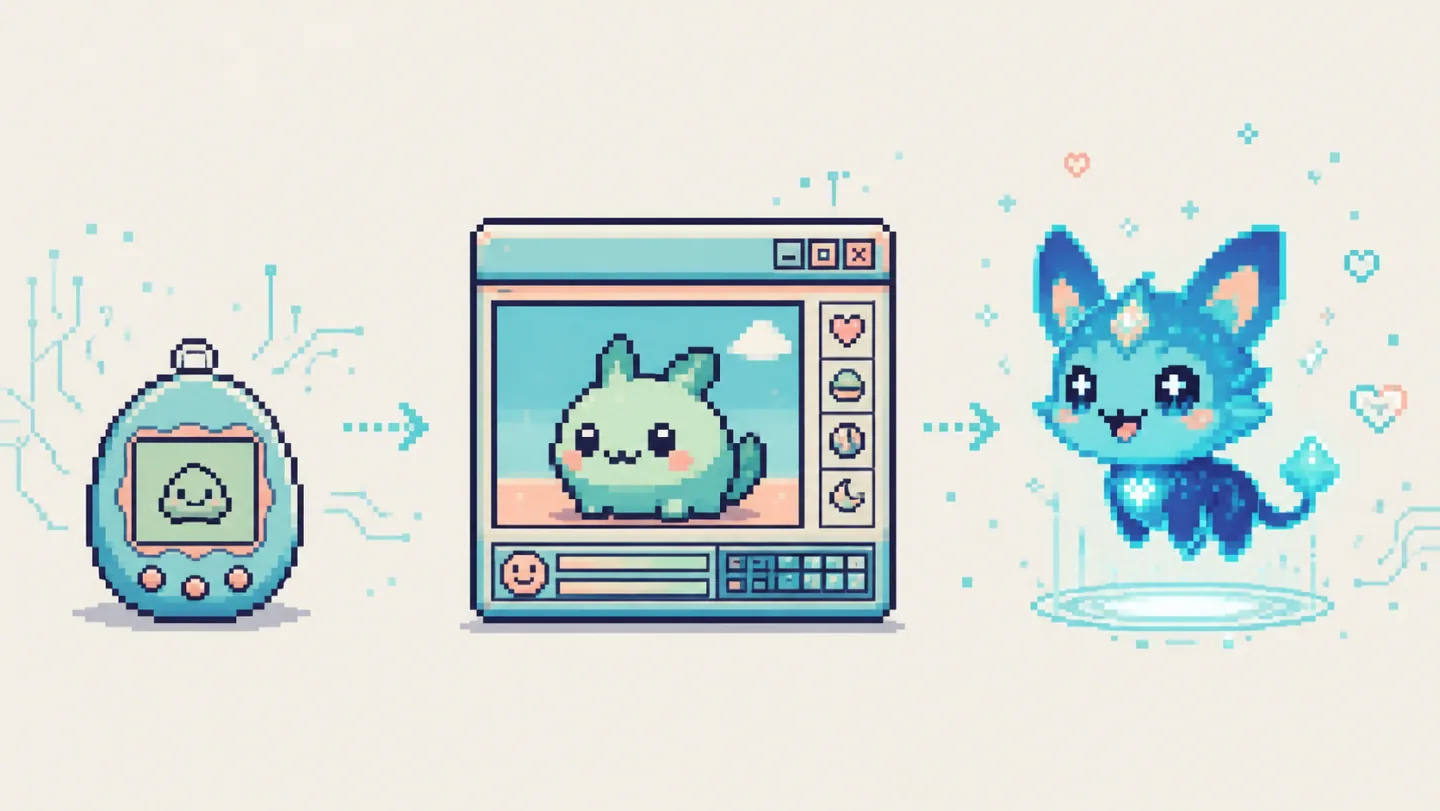
In November 1996, Bandai released a plastic egg the size of a walnut with a 32-by-16 pixel screen and three buttons. Within a year it had sold twenty million units, caused school bans on three continents, and created a market that now spans mobile apps, MMOs, blockchain experiments, and AI companions with real personalities. The history of virtual pets is a story about how little it takes to make a person care about something that isn't alive, and about how much that "something" has learned to give back.
This guide covers the complete arc of digital pets, from the first experiments on home computers in the 1980s to the large-language-model companions of 2026. If you want the physical robot side of the story, read our companion guide on the history of robot pets from Sony AIBO to today. This one is about pets that live on screens.
The Prehistory: Pets Inside Computers (1985–1995)
The first creature most people cared for on a screen wasn't a pet at all. Activision's Little Computer People (1985) for the Commodore 64 and Apple II put a tiny man in a cross-section house on your monitor. He cooked, read, played piano, and asked you to play cards with him. You could type him letters, and he would write back. There was no objective and no score, just a being who seemed to have a life when you weren't looking. Designer Rich Gold called it a "house on a disk," and it established the core fantasy of every digital pet since: something is living in there, and it knows you.
Dogz (1995) from PF.Magic took the idea further on Windows and Mac. A puppy lived on your desktop, chased a ball with your cursor, and could be taught tricks. Catz followed in 1996, and the Petz series eventually sold millions, with a breeding system that let pets pass traits to offspring. Petz is rarely given credit, but it introduced genetics, emergent personality, and a fan community that traded pets online, all before Tamagotchi existed.
Meanwhile in Japan, Creatures creator Steve Grand in the UK was building something far stranger. Released in 1996, Creatures featured "Norns," artificial life forms with simulated neural networks, biochemistry, and genomes that actually mutated across generations. It remains one of the most scientifically ambitious digital pet games ever made.
1996: Tamagotchi Changes Everything
Aki Maita, a young Bandai employee, reportedly got the idea from a TV commercial showing a boy trying to sneak his turtle to school. The concept she pitched with WiZ designer Akihiro Yokoi was simple: a pet small enough to carry anywhere that would die if you neglected it.
The Tamagotchi launched in Japan on November 23, 1996. The egg-shaped keychain held a creature that hatched, ate, pooped, got sick, played a guessing game, and grew through life stages into one of several adult forms depending on how well you cared for it. Ignore it and it would beep. Ignore it long enough and it died, replaced by a small pixel gravestone (in Japan) or a ghost and angel (in the US version, because Bandai America thought death was too dark).
Demand was instant and irrational. Bandai sold 400,000 units in the first month and over ten million within a year. Tokyo stores had lines around the block, counterfeits flooded Asian markets, and the US launch on May 1, 1997 at FAO Schwarz sold 30,000 units in three days. Schools banned them because children were refusing to let their pets die during class. Bandai, facing a classic bubble, overproduced. By 1998 the company was writing off 6 billion yen in unsold inventory and the fad appeared to be over.
It wasn't. Tamagotchi Connection (2004) added infrared so two pets could visit and breed. Tamagotchi iD and P's in Japan added color screens and downloadable items. Tamagotchi On (2018–2019) introduced genetics, where two-parent offspring blended traits. Tamagotchi Uni (2023) added Wi-Fi and a global metaverse called Tamaverse. Tamagotchi Paradise (2025) let players zoom in to the cellular level of their pet.
The revival was real. In 2025, Bandai announced that cumulative shipments had passed 100 million units worldwide, driven by "kidults" rediscovering the toy and Gen Z discovering it fresh. Tamagotchi turns thirty in November 2026 and has outlasted nearly every gadget launched alongside it.
The Virtual Pet Wave (1997–2000)
Tamagotchi's success triggered hundreds of clones and a handful of genuine innovations.
Digimon (1997) was Bandai's own answer to the complaint that Tamagotchi was for girls. A square-bodied "Digital Monster" that you trained for battle and connected to other devices to fight spawned an anime, card game, and video game franchise that still exists.
Giga Pets (1997) from Tiger Electronics were the biggest US competitor, with themed pets from a compu-kitty to Pixar's Toy Story characters. Nano Pets from Playmates, Dinkie Dino, and dozens of imitation devices filled checkout aisles.
Pokémon (1996 in Japan, 1998 in the US) isn't usually called a virtual pet, but the Pokémon Pikachu pedometer (1998) literally was one, and the entire franchise rests on the same emotional engine: creatures that grow because you care for them. Pokémon Yellow's Pikachu following you around and reacting to your treatment of it is one of the most-played virtual pet mechanics in history.
On the PC, Creatures 2 (1998) and Petz 3 continued their lineages, while Sony's PlayStation got Seaman (1999 on Dreamcast), a grumpy fish-man voiced by Leonard Nimoy in the US who talked back to you through a microphone. Seaman was, arguably, the first conversational virtual pet.
The Online Era: Neopets and Webkinz (1999–2010)
The web turned virtual pets from a solitary hobby into a social economy.
Neopets, launched in November 1999 by two British students, let users adopt fantasy creatures, earn Neopoints through flash games, and buy items in a player-run economy. By 2005 it had 25 million users and had been acquired by Viacom. Neopets pioneered freemium virtual pet monetization, had an in-game stock market that taught a generation about finance, and its pets, uniquely, couldn't die (they just got hungry and sad, which was somehow worse).
Webkinz (2005) from Ganz fused plush toys with online pets: each stuffed animal came with a code that unlocked its digital twin. Ganz sold over a million plush in its first year and the model has been copied endlessly since, including by modern AI pet makers who pair a physical object with a digital personality.
Nintendogs (2005) on the Nintendo DS was the artistic peak of the era. Using the DS touchscreen and microphone, you petted, washed, and trained remarkably lifelike puppies, who learned their names from your voice. It sold 24 million copies, becoming one of the best-selling games ever, and proved that realistic animal behavior, not cartoon abstraction, could carry a pet product. Nintendogs + Cats (2011) added facial recognition through the 3DS camera so your dog would greet you when you looked at it.
The late 2000s also brought Moshi Monsters (2008) for kids, Club Penguin's puffles, and Sony's EyePet (2009), an augmented-reality creature that lived in your living room via the PlayStation Eye camera, a direct ancestor of every AR pet since.
The Mobile Era: Pets in Your Pocket (2010–2020)
Smartphones should have been the perfect home for virtual pets, and in one sense they were: the numbers were enormous. Talking Tom Cat (2010) from Outfit7 repeated whatever you said in a squeaky voice and has been downloaded more than 20 billion times across its franchise. Pou (2012), a Tamagotchi-style blob, passed 500 million downloads. My Tamagotchi Forever (2018) officially brought the egg to iOS and Android.
But mobile also flattened the genre. Most pet apps became ad-funded minigame collections with a mascot attached. The emotional core that made Tamagotchi land, a creature with needs that you alone were responsible for, was diluted by daily-login rewards and in-app purchases.
Two games pushed back. Pokémon GO (2016) put creatures in the physical world with augmented reality and a "buddy" system that let a single Pokémon walk beside you and earn candy. And Animal Crossing: New Horizons (2020) became the pandemic's defining game, with villagers who remembered conversations and wrote you letters. Neither is a pet game strictly, but both showed that people still craved persistent relationships with digital creatures.
A third branch emerged in 2017 with CryptoKitties, the first major blockchain pet. Each cat was a unique NFT with breedable "cattributes," and at its peak it clogged the Ethereum network. Axie Infinity (2018) turned the model into play-to-earn and briefly generated over a billion dollars in trading volume in 2021 before collapsing. Blockchain pets proved that ownership and scarcity could drive engagement, and also that speculation could kill it.
The AI Era: Pets That Actually Know You (2020–2026)
Everything before 2020 ran on state machines: hunger goes up, happiness goes down, press button, repeat. Large language models and modern speech synthesis broke that ceiling.
The first wave was AI companions rather than pets. Replika (2017) let users build an AI friend that remembered conversations, and by 2024 it claimed over 30 million registered users. Character.AI (2022) let anyone create personas, including animal ones, and hit 20 million monthly users. These weren't marketed as pets, but a large share of users treated them exactly like one: something to check in on, talk to, and feel responsible for.
The second wave applied that technology to explicitly pet-shaped experiences. Conversational virtual pets on mobile now hold real memory of your life. Desktop companions like those built on emerging character platforms combine animated creatures with LLM dialogue. At CES 2026, Takway's Sweekar showed a physical Tamagotchi-style device with a screen, voice recognition, memory of past interactions, and a growth arc from egg to adult. The press called it "an AI Tamagotchi," which tells you where the category's center of gravity has moved.
And Bandai itself is in on it: the Tamagotchi Uni's Tamaverse and the 30th anniversary roadmap lean heavily on connectivity and personalization. Digital pets now span toys, games, apps, and connected companion hardware rather than one toy-aisle category.
This history also shapes AI Pets: a small physical companion with a persistent character, expressive pixel animation, voice, and owner-controlled memory. It carries the continuity of a digital pet into a dedicated object without reducing the relationship to a hunger meter.
Five Lessons from Thirty Years of Virtual Pets
Responsibility is the hook. Tamagotchi's genius was consequence. Pets that can't suffer from neglect (Neopets, most mobile apps) retain users for habit rather than love.
Death is a feature. The Japanese Tamagotchi let your pet die; the US version softened it. Collectors and fans overwhelmingly preferred the original. Stakes create attachment.
Scarcity and uniqueness sell. From Petz genetics to Tamagotchi On breeding to CryptoKitties, the promise that your pet is unlike anyone else's has driven every major spike in the genre.
Social layers extend lifespan. Tamagotchi Connection, Neopets, Webkinz, and the Tamaverse all added years to their products by letting pets meet.
Intelligence changes the contract. A pet that remembers your name, your bad day, and your birthday is asking for a different kind of relationship than one that beeps when hungry. Designing that relationship responsibly is the central challenge of the AI era.
Digital Pet Timeline
| Year | Milestone |
|---|---|
| 1985 | Little Computer People (Activision) |
| 1995 | Dogz, the first desktop pet |
| 1996 | Tamagotchi launches in Japan (Nov 23); Creatures released |
| 1997 | Tamagotchi reaches the US; Digimon and Giga Pets debut |
| 1999 | Neopets launches; Seaman talks back on Dreamcast |
| 2004 | Tamagotchi Connection adds infrared |
| 2005 | Nintendogs and Webkinz |
| 2009 | Sony EyePet brings AR pets |
| 2010 | Talking Tom Cat on iOS |
| 2012 | Pou passes hundreds of millions of downloads |
| 2016 | Pokémon GO |
| 2017 | CryptoKitties; Replika launches |
| 2018 | Tamagotchi On adds genetics |
| 2022 | Character.AI |
| 2023 | Tamagotchi Uni adds Wi-Fi and Tamaverse |
| 2025 | Tamagotchi passes 100M units; Tamagotchi Paradise |
| 2026 | Sweekar AI Tamagotchi at CES; Tamagotchi turns 30 |
Frequently Asked Questions
What was the first virtual pet? Little Computer People (1985) is the earliest widely recognized digital companion. Dogz (1995) was the first desktop pet, and Tamagotchi (1996) was the first handheld virtual pet and the one that created the mass market.
How many Tamagotchis have been sold? Bandai announced in 2025 that cumulative worldwide shipments had exceeded 100 million units since 1996.
Is Tamagotchi still popular? Yes. Tamagotchi Uni (2023) and Tamagotchi Paradise (2025) have driven a significant revival among adults who grew up with the original and younger players discovering it for the first time.
What is an AI virtual pet? An AI virtual pet uses machine learning, usually a large language model plus a personality and memory system, so that the pet converses naturally, remembers past interactions, and develops a personality shaped by its owner, rather than just cycling through fixed needs.
Can a virtual pet help with loneliness? Research on AI companions suggests they can reduce feelings of isolation for some users, particularly when designed to encourage rather than replace human connection. Virtual pets add the element of care and routine that many people find grounding.
Related reading on aipets.com: The History of Robot Pets: From Sony AIBO to Today · Are AI Pets Good for You? What the Science Says · The Future of AI Pets and Digital Companions