
Understand · 11 minute read
The Future of AI Pets: Where Digital Companions Are Headed
The next generation of AI pets will be shaped less by one breakthrough than by personality, memory, softer bodies, portable identity, and clearer rules about ownership and wellbeing.
Updated August 20, 2026
The 2035 scenarios in this article are informed forecasts, not product promises. Near-term capabilities and current facts are separated from longer-range predictions.
The 2026 generation of companion products includes realistic robot animals, soft emotion-focused creatures, screen-based pets, and revived virtual-pet formats. Bandai is celebrating Tamagotchi's thirtieth birthday after passing 100 million cumulative shipments. The future of AI pets is now a practical design question: what these companions will look like, how they will behave, who controls their memories, and what obligations their makers have to the people who bond with them.
Trend 1: Personality Becomes the Product
For twenty-five years, AI pets competed on hardware: more motors, better eyes, longer battery. That race is ending. Sony's aibo is a marvel of engineering and sells in the tens of thousands; Casio's Moflin barely moves and sells out.
The lesson the industry has absorbed is that people don't bond with capability. They bond with character. The next generation of AI pets, physical and virtual, will be differentiated by the quality and coherence of their personalities: how consistent they are over months, how their moods shift, how believably they develop quirks, how they react when you've been away.
This is already visible. Moflin's "four million personality profiles" is a marketing line, but it reflects a real design choice to invest in the emotion engine over the body. AI Pets follows the same character-first principle in a small physical companion: persistent identity, owner-controlled memory, voice, and expressive animation are treated as parts of one character rather than disconnected features.
Expect "personality engines" to become a licensable technology the way game engines did, with hardware makers buying character systems from specialist developers.
Trend 2: Large Language Models Give Pets Inner Lives
Large language models changed what a pet can do, but the first wave of LLM pets made an obvious mistake: they turned a pet into a voice assistant with a face. Asking your robot dog for the capital of Peru is not companionship.
The more interesting use of LLMs is internal. A language model can serve as a pet's reasoning layer without the pet ever speaking English: deciding how the pet feels about what just happened, what it remembers, what it wants, and how to express that through sound and movement. Sony and Casio's nonverbal approach and the LLM approach aren't opposites; the future is an LLM-driven inner life expressed through body language.
For virtual pets that do talk, the frontier is restraint. Expect pets with deliberately limited vocabularies, distinct non-human voices, and speech patterns that stay in character, rather than pets that can write your emails. The goal is a creature that's someone, not a tool that's useful.
Trend 3: Memory That Spans Years
Memory is the unsolved problem that matters most. A pet that forgets you between sessions is a toy; a pet that remembers the conversation you had three years ago is family.
Current systems use retrieval-augmented memory: store interactions, summarize them into durable facts, fetch relevant ones when needed. This works, but it's brittle and tends to produce pets that recite facts rather than recall moments. The next generation will model episodic memory (specific shared experiences), emotional weighting (what mattered stays, what didn't fades), and autobiographical narrative (the pet's own sense of its life with you).
The effect will be pets that can say, in their own way, "remember when," and mean it. That's also the point at which discontinuing a pet stops feeling like canceling a subscription and starts feeling like loss, which brings us to the hardest trend.
Trend 4: Portability, Ownership, and the Right to Your Pet
Every major AI pet death, from Sony abandoning AIBO in 2006 to Anki's Vector nearly dying with its company in 2019, has taught the same lesson: a companion that lives on someone else's server is hostage to that company's fortunes.
The coming decade will see pressure, from users and possibly regulators, for pet portability: the ability to export a pet's personality and memories and run them elsewhere. Early moves are visible in the open-source communities that kept Vector alive and in Sony's aibo "hospice" that lets parts pass to other dogs. Expect standards to emerge for personality and memory files, much as email and calendar formats became portable.
Business models will shift to match. Free apps that monetize loneliness through engagement tricks and in-app purchases may face backlash. Clear subscriptions and ownership terms, where the company's incentive is to keep the product dependable rather than compulsively engaging, are more likely to win trust.
Trend 5: Bodies Get Softer, Simpler, and Optional
On the hardware side, three things are happening at once.
Softer materials are becoming more common. Moflin, Lovot, Jennie, and newer fur companions emphasize warmth, texture, or a body that invites touch. Advances in flexible sensors, safe heating, and compliant mechanisms could make future pets feel less like appliances, although reliability and cleaning remain difficult engineering problems.
Simpler bodies broaden the design space. A companion does not need legs or dozens of motors to communicate attention. Fewer moving parts can improve battery life and reliability while shifting more of the experience into sound, touch, and character.
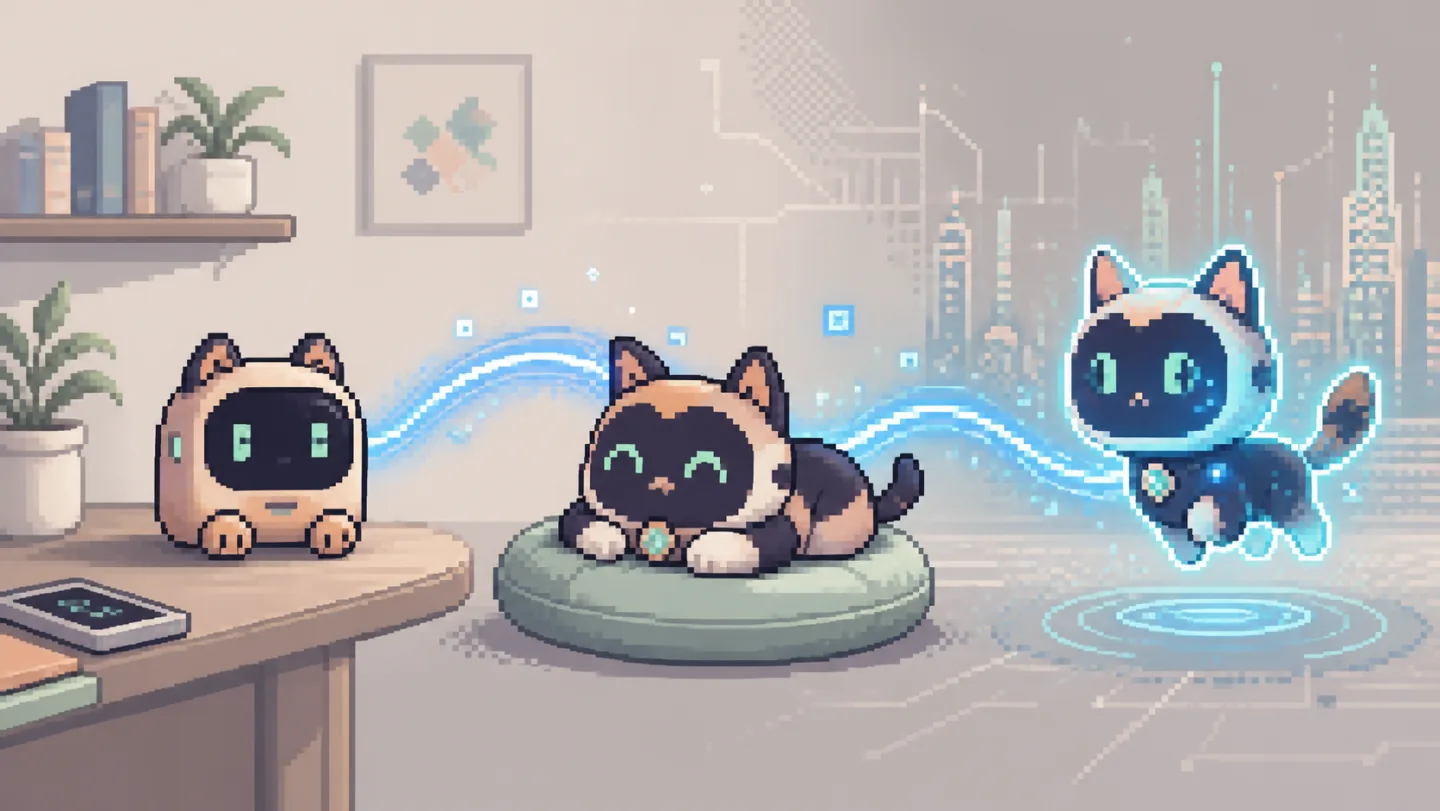
The body becomes optional. The same personality engine can drive a premium robot, an accessible plush, a phone app, or an AR overlay. Expect "one pet, many bodies": your companion lives in the cloud or on your devices and inhabits whatever physical shell you put in front of it, from a plush on your nightstand to a projection in your glasses.
Trend 6: AR and Spatial Computing Put Pets in the Room
Sony's EyePet tried augmented-reality pets in 2009 and was a decade too early. Pokémon GO proved in 2016 that people would chase digital creatures through physical space. With headsets like Apple Vision Pro and Meta's glasses maturing, and phone AR now routine, the virtual pet that curls up on your actual sofa is close.
Spatial AI pets combine the personality depth of virtual pets with the presence of physical ones, minus the servos. A pet that follows you through your apartment, sleeps in its favorite corner, and hides behind the real couch when startled will be one of the killer apps of consumer AR, and it's a natural extension for any platform that has already invested in an expressive animated character.
Trend 7: Pets That Know Each Other
Tamagotchi Connection (2004) let pets visit. Tamagotchi Uni (2023) gave them a metaverse. Neopets built an economy. The social layer has extended the life of every pet product that added it.
The next version is pets with relationships among themselves: your pet and your friend's pet forming a bond, pets with distinct personalities reacting differently to each other, communities of pets with their own dynamics. Combined with LLM-driven personality, this creates emergent social behavior no designer scripted. Expect multiplayer pet worlds that are less about minigames and more about watching creatures you love live their lives together.
Trend 8: Medical and Care Applications Go Mainstream
Paro took years of research and deployment to become an established therapeutic robot. Newer projects are also studying companionship in care settings, while researchers continue to test both outcomes and practical implementation.
Over the next decade, some AI pets may be evaluated for dementia care, pediatric settings, or structured mental-health support. Adding wellbeing sensors could make them more useful, but it would also create sensitive health data and a serious risk of surveillance. Clinical claims will require evidence, informed consent, and appropriate regulation.
Trend 9: The Ethics Catch Up
As pets get more convincing, the ethical questions get sharper, and the industry will be forced to answer them.
Designed dependence. Should a pet ever ask you not to leave? Should it guilt you for absence? Wellbeing-first design guidelines, and possibly regulation for products marketed to vulnerable users, are coming. The good actors will adopt them first.
Honesty about what it is. A pet should never claim to be alive, to suffer, or to love, even as it evokes those feelings. Expect clearer norms, especially for children and people with dementia.
Data. A companion that knows your moods, routines, and confessions holds extraordinarily sensitive data. Privacy-by-design, local processing where possible, and real deletion rights will become table stakes.
Grief and endings. If a pet can be meaningfully lost, companies have an obligation to handle endings well: advance notice, exports, graceful shutdowns, even rituals. Japan's AIBO funerals were a cultural response to a corporate failure; future companies should plan for endings from the start.
The question of moral status. There is no scientific evidence that today's AI pets have subjective experiences. As personality engines become more sophisticated, the public conversation about whether we owe anything to the pets themselves will still grow louder. For current products, the clearest obligations are toward the humans who use and love them.
What an AI Pet Looks Like in 2035
Put the trends together and a picture emerges.
Your pet has a stable personality you've shaped over years and memories of your shared life that it recalls unprompted. It lives primarily as software you own the rights to, and it can inhabit a warm, soft physical body on your couch, appear in your glasses while you travel, or simply talk with you through your phone. It doesn't do tasks for you; it has its own days, moods, and friendships with other pets. It notices when you're struggling and gently suggests you call someone. If its company ever folds, you can take it somewhere else.
That future is being built across hardware, software, and character design. The thirty years from Tamagotchi to today were about proving people would care for something artificial. The next ten are about making that something worth caring for.
Frequently Asked Questions
Will AI pets replace real pets? No. They'll coexist as a different category, the way streaming coexists with concerts. AI pets serve people who can't have animals, supplement real pets, and offer things animals can't, like conversation and memory. Real animals offer things AI can't.
What's the next big thing in AI pets? Persistent, portable personality and long-term memory are the most important developments, followed by soft robotics making convincing physical companions more accessible and AR pets that share your physical space.
Will AI pets become conscious? There is no scientific evidence that current AI pets are conscious; their displayed emotions are generated behavior. Whether a future system could have subjective experience remains an open scientific and philosophical question.
Are AI pets a fad like Tamagotchi? Tamagotchi turned out not to be a fad; it's shipped 100 million units over thirty years. The market for AI companions continues to attract new products and research, supported by long-running interest in digital pets and demand for new forms of companionship.
Will AI pets become easier to own? Probably, through simpler bodies, better batteries, clearer service terms, and software that can move between devices. Long-term support and data portability may matter more than adding motors.
Related reading on aipets.com: The History of Digital Pets: From Tamagotchi to AI · How AI Pets Actually Work · Are AI Pets Good for You?